College Admissions News: Key Trends and Updates
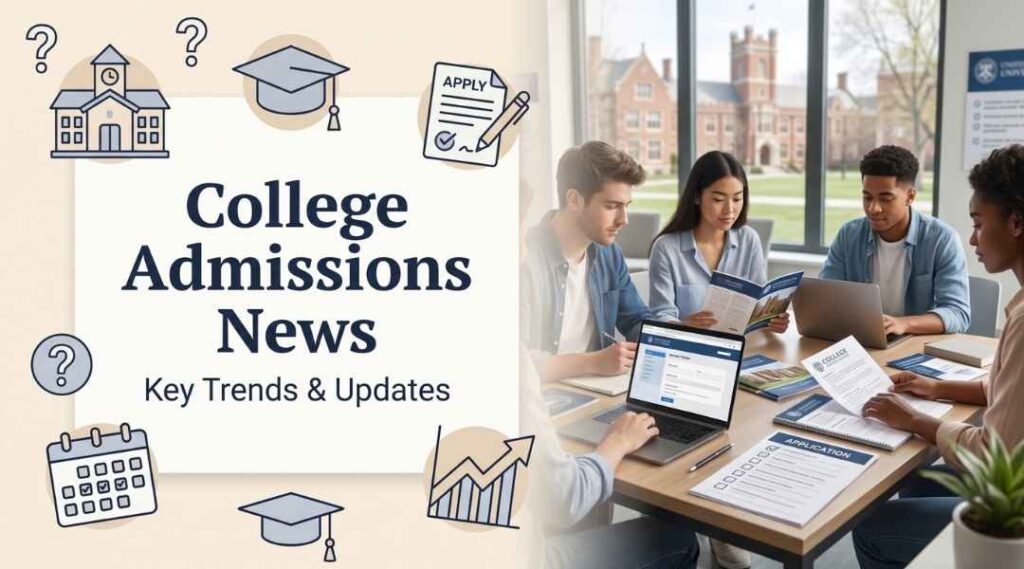
College admissions news is a great resource for students, faculty, counselors and families to stay up to date for learning and planning. Giving grades and research papers are no longer sufficient for college admission. Student learning outcomes can be impacted by changes in testing policies and their affordability, performance requirements, discretion, enrollment patterns, and institutional priorities.
The new college admission process is easier to understand for educators and to help students navigate a more complex process. College application news can be a valuable resource for students, providing them with information about the colleges they are interested in attending and how to prepare for their applications.
In this blog, we’ll examine some of the biggest college admission trends, recent changes in the college admissions landscape, and the lessons to be learned by students and faculty about the evolving nature of admission.
Table of Contents
Why College Admissions News Matters
College admissions process are constantly changing. University policies, programs, may be adjusted, new programs created, financial aid procedures may be adjusted or research requirements may be adjusted. If a student uses old information, he or she might miss out on an opportunity or prepare for requirements that are no longer applicable.
After attending college admissions news can help students gain a deeper understanding of the variety of context in which admissions decisions are made.
It can provide useful information about:
- Changes in admission requirements
- Standardised testing policies
- Application platforms and essay requirements
- Financial aid and affordability
- University enrolment patterns
- International student policies
- New academic programmes and pathways
For teachers and educational consultants, these developments are equally important. Students often turn to academics for guidance, which means that education authorities need a greater understanding of current higher education admissions developments.
Changing College Enrollment Trends Are Reshaping Admissions
One of the biggest issues affecting today’s college admissions trends is changing demographics. In the United States, the number of traditional college students is expected to decline in several regions in the coming years, although the impact will not be the same everywhere.
Recent reports have shown widening disparities between regions. Student numbers are expected to rise sharply in parts of the south while declining in parts of the Northeast and other regions. These changes may result in increased competition among institutions for a subset of applicants.
Note that this is not to say that getting into all the colleges will be straightforward.
Universities that are selective will have the ability to appeal to a wide range of people, both locally and globally. Therefore, even if there are fewer college students, places may be available at top-notch institutions through the competition. Meanwhile, some regional institutions may become more accessible as they work to maintain enrollment.
For students, this presents an important lesson: the college enrollment trends must be understood as well as the competition and mission of each institution.
Affordability Is Becoming a Major Part of College Decisions
Academic quality remains important, but affordability is becoming an increasingly significant part of the student admissions journey.
Students are increasingly asking practical questions before accepting an offer:
- What will the total degree cost?
- How much financial aid is available?
- Will the qualification support future career opportunities?
- Can the institution demonstrate strong academic and employment outcomes?
- Are there sufficient funds available?
When it comes to enrollment decisions, a new survey of 2026 admitted students revealed that affordability and confidence in the long-term sustainability of an institution are important factors to consider.
This is a significant factor for teachers because college guidance shouldn’t just be about getting accepted. It is also important for students to be supported in the realistic comparison of institutions.
Academic competition is not always in the best interests of the student when it causes undue stress through financial commitment. It is the role of faculty and counselors to help students focus on more than just the grades in the university and consider the totality of the educational experience.
Standardised Testing Policies Continue to Evolve
Testing remains one of the most discussed areas of college application news. Different colleges now follow different approaches to standardised examinations.
Depending on the institution, a student may encounter policies such as:
- Test-required admissions
- Test-optional admissions
- Test-flexible admissions
- Test-blind admissions
This variety means students should avoid making assumptions based on what other colleges are doing. Instead, they should review the official requirements of every institution on their application list.
There are still many questions surrounding the policy for admissions related to educational readiness, fairness, access, and the significance of scores. Recently, for instance, there has been a debate about test and grading preparation at the University of California about the continued rethinking of the connection between test scores and student preparation.
A main takehome message for the faculty is that a single admissions approach is not suitable for every university.
College Applications Are Becoming More Strategic
There is a general perception among students that the more applications they submit, the better their chances of getting into a school. However, recent analysis suggests there is no universal “correct” number of colleges for every applicant.
Depending on academic standing, interest in academic studies, financial status, competitiveness of institutions, the appropriate score varies. Randomly applying to several universities isn’t always as effective as creating a good list.
Students should consider having a mix of institutions in mind that represent different levels of admission.
A balanced college list may include:
Likely options
Institutions where the student’s academic profile compares favourably with typical admitted applicants.
Target options
Colleges where the student’s qualifications are generally competitive.
Reach options
Competitive events but the results are not guaranteed.
This can help students to think strategically instead of emotionally. It also supports teachers and counselors to offer more standardized direction on the college admissions process.
Application Requirements Are Expanding Beyond Academic Scores
While grades continue to be vital, many schools adopt a more holistic perspective in considering applicants.
Depending on the college and programme, college admissions requirements may include:
- Academic performance
- Personal essays
- Recommendation letters
- Extracurricular involvement
- Portfolios
- Interviews
- Test scores
- Evidence of leadership or community involvement
A more comprehensive performance review is usually aimed at understanding a student’s readiness for learning and ability in a variety of ways.
Students are not required, however, to take part in all activities. Sometimes small and long lists of responsibilities are not as crucial as meaningful involvement and real interests.
Encourage students to build good academic and personal interests and help them by no end-term professional profile creation.
With the advent of Artificial Intelligence, new questions are being raised for admissions.
Artificial Intelligence Is Creating New Questions for Admissions
The news of college admissions has been revolutionized by artificial intelligence.
Students have access to tools that can assist with critical thinking, creativity, organization and research. In parallel, colleges are growing more worried about the discrepancy between acceptable contributions and those that don’t actually embody the applicant. This is especially useful for application scripts.
The purpose of entry writing is to capture the student’s attitude, experience and ability to think. If intellectual property produces all the writing, the final research may no longer accurately reflect the researcher.
The growing discussion around AI means students need to develop responsible academic habits.
AI can be useful for:
- Brainstorming possible topics
- Improving organisation
- Identifying grammar mistakes
- Generating questions for reflection
Students should be cautious about using AI to:
- Write an entire personal statement
- Invent personal experiences
- Create false achievements
- Produce work they cannot explain or defend
Teachers play a crucial role in teaching students the responsible and effective use of AI. The aim should be to use technology as a learning tool, not a replacement for original thinking.
Admission Policies Are Receiving Greater Public Attention
Another big part of the higher education news is the ongoing discussions about fairness and legality in admissions policies.
Governments, courts, universities, and the public have paid close attention to access. A recent federal investigation of some U.S. universities shows how issues related to diversity and research evaluation can quickly become major political discussions.
For students and faculty, these factors increase the importance of collecting official data.
Admissions policies can change because of:
- Court decisions
- Government regulations
- Institutional policy reviews
- Changes in university priorities
Therefore, students should completely avoid relying on social media or old admission books.
International Students Need to Follow Policy Changes Carefully
When applying to colleges in another country, there are other factors that international students need to take into consideration. In addition to academic requisites, they should be familiar with:
- Visa regulations
- English-language requirements
- Financial documentation
- Scholarship eligibility
- Immigration timelines
- Institutional support services
Changes to student visa and immigration policies can directly affect university planning. Recent admissions reporting has identified international student policy as an important area for applicants to monitor.
Thus, for international students, the application process must consist of two distinct preparation processes: gaining admission and ensuring that all legal and financial requirements for study abroad can be met.
Faculty working with international applicants should encourage students to begin researching these requirements as soon as possible.
College Application Deadlines Require Better Planning
Missing a deadline can be one of the easiest ways to lose your admission.
College application deadlines can vary by institution and application path. Students have access to
- Early application deadlines
- Regular admission deadlines
- Rolling admissions
- Scholarship deadlines
- Financial aid deadlines
One common mistake is to assume that only a fixed search period is a relevant date. Application forms, financial aid forms, housing application forms, and supporting materials may require separate schedules.
Students must create an admissions calendar that includes all important dates.
A useful admissions calendar should track:
- Application opening dates
- College application deadlines
- Test registration dates
- Recommendation deadlines
- Scholarship deadlines
- Financial aid deadlines
- Interview dates
- Admission decision dates
- Enrolment confirmation deadlines
This simple planning strategy can reduce unnecessary stress and help students remain organised.
What Educators Can Learn From Current College Admission Updates
Teachers and counselors don’t need to be admissions officers to help students effectively.
However, knowing the latest university admissions update can help educators provide more relevant guidelines.
Encourage students to research independently
Propose that students do their own research and work together.
Students should be taught how to access official university sources and to find trustworthy sources of information.
Teach long-term preparation
College preparation begins before the end of the school year. Reading skills, reading skills, writing skills and subject matter knowledge develop gradually.
Focus on realistic choices
Students must be encouraged to investigate institutions where they would like to attend that fit their academic interests, financial situation, and career goals.
Develop strong writing skills
Writing personal statements and service essays is easier if students practice reflective and academic writing regularly.
Discuss affordability openly
Financial planning should be treated as an important part of higher education decision-making rather than an afterthought.
How Students Can Stay Updated With College Admissions News
Students don’t need to follow every single news story about the university. Rather, they need to concentrate on information that may possibly impact their study plans in their case.
Reliable sources include:
- Official university admissions websites
- Government education departments
- Recognised application platforms
- Official testing organisations
- Trusted higher education publications
- School counselling offices
Students should also note whether or not the information is relevant to their particular year of entry.
One years policy does not necessarily mean the next. Part of being able to read college admissions news is being able to read the dates.
The Future of College Admissions
Changes in education and society are likely to continue to be reflected in the future.
Technology can transform the process of completing forms. Enrollment patterns may be influenced by demographic changes. Financial pressures can affect where students study. Probation standards can often vary between agencies.
At the same time, part of this process is unlikely to disappear: colleges will continue to try to determine whether applicants are ready to succeed in their academic environment.
For students, a good plan is often bigger than just building an impressive career. Skills in study habits, interest in academic inquiry, communication and decision making, continue to be important in all settings of individual admission criteria.
Final Thoughts
Staying up to date on college admissions news can enable students and educators to gain insight into the evolution of higher education, from testing to affordability, to enrollment to application rules. The best approach is to keep up to date, but not overwhelmed with information.
Effective college planning for students involves current college admissions information, smart research, realistic objectives, and the consideration of state requirements, coupled with a solid academic preparation. Keeping an eye on college admissions trends can help educators make informed, productive choices and help direct students toward their future.
.